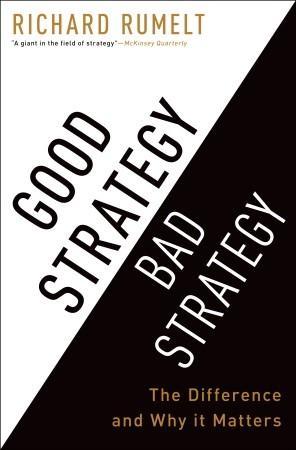
Good Strategy Bad Strategy
by Richard Rumelt
Date Read: October 19, 2026
Good Strategy/Bad Strategy — What I Learned About Real Strategy
Before reading Good Strategy/Bad Strategy by Richard Rumelt, I think it was easy to view strategy as a company's goals, mission, or overall plan for where it wants to go. You hear so many long winded sentences that sound like a confusing way to say “we want to be great, and grow!” in the corporate world. But one of the biggest things I took away from the book is that this isn't really strategy.
A company saying it wants to grow 30% isn't a strategy. Everyone wants to grow. There is no diagnosis, no steps, and no actual plan for how to make that growth happen. Growth is a product of strategy.
By strategy, Rumelt means something closer to a hypothesis, with a detailed plan and actionable moves that define how a company is going to approach its most important challenge.
A good strategy is focused, actionable, concentrated, simple, and clear. A bad strategy is full of goals, missions, buzzwords, and vague objectives without real action steps focused on the most important things.
The Kernel of Good Strategy
The clearest framework from the book is what Rumelt calls the kernel of good strategy:
Diagnosis → Guiding Policy → Coherent Action
The diagnosis is recognizing the most important issue at hand.
The guiding policy is a clear route for how you're going to solve or attack that problem.
The coherent actions are the actual steps you take to execute that guiding policy.
This sounds simple, but I think that's part of the point. Good strategy should be simple enough to explain because you actually understand the problem.
You aren't just saying what you're going to do. You understand how and why you're going to do it.
The diagnosis especially stood out to me. Before making plans, you have to face the reality of the challenge and identify what actually matters most.
If you diagnose the wrong problem, everything that follows can be perfectly executed and still fail.
Goals Are Not Strategy
One of the easiest traps to fall into is mistaking goals for strategy:
- “Grow revenue 30%.”
- “Become the market leader.”
- “Deliver world-class customer service.”
- “Become the most innovative company in the industry.”
These might be goals, but they don't tell you how you're going to accomplish anything. There is no diagnosis. There is no guiding policy. There are no coherent actions.
This is where Rumelt's idea of fluff comes in. Fluff is the fake corporate language and buzzwords that sound strategic without actually containing strategic substance.
Bad strategy can look impressive because it contains ambitious goals, complicated language, and long lists of initiatives. But none of those things necessarily answer the most important question:
What is the central challenge, and what are we going to do about it?
Strategy Requires Focus and Hard Choices
Another major takeaway for me was that strategy requires concentration.
You can't just create a massive to-do list of everything that could possibly improve the company. You have to make hard choices.
Finding the central challenge helps determine what deserves your attention and where resources should be concentrated. That means deciding what not to do too.
A good strategist looks for points of leverage — places where concentrated effort can create an outsized result.
Rather than trying to improve everything, figure out your strengths and double down on them. Understand your advantages and the advantages of your competitors. Analyze the competitive landscape and look for pockets, openings, and targets where those advantages can matter most.
The strategist is, in many ways, a master of design. The different pieces of the strategy have to work together.
Coherent Actions Matter
This connects to another concept I liked: the chain-link system.
In a chain-link system, every part has to work. It reminds me of how Andrew Grove describes the process of making breakfast. Sure, the coffee is hot for the customer, but what good is that if nobody even started to boil the egg? These things need to work together to make operations work.
Having one incredible piece doesn't necessarily matter if another critical piece fails.
That means strategy isn't simply about having ten individually good ideas. The actions need to reinforce each other. There needs to be coherence.
This also reinforced why simply creating a giant list of initiatives isn't strategy. A strategy should direct different actions toward solving the same central challenge. Everyone should understand how the system works, their role, and why coherence is important.
Anticipating Change
Some of the examples that stuck with me most involved companies anticipating and adapting to change. The way Rumelt describes it, and the message I took was: you must see the wave coming, otherwise you will get smothered by it.
NVIDIA was one example I remembered particularly well.
A strategist shouldn't only analyze the world as it exists right now. You have to develop an understanding of where things may be going. Studying history is hugely important for this.
Industries and businesses don't change randomly. There can be signals: rising fixed costs, deregulation, predictable biases, incumbents being threatened, changes in technology, and what Rumelt describes as attractor states, which is basically a clear path to where an industry appears to be heading. Like for most companies, AI is a wave that is very clearly going to drive the future; there is no point in acting like that attractor state doesn't exist.
You have to try to anticipate the wave.
That doesn't mean blindly predicting the future. It means studying the facts, understanding history, looking at the competitive landscape, and recognizing important pivot points before everyone else does. If you don't study history you won't recognize the signs. If you don't understand the underlying fundamentals pushing the wave, you won't know where to start in terms of adjustment and anticipation.
Then, you have to use those pivot points as leverage and concentrate your effort.
Inertia, Entropy, and Change
Companies don't automatically adapt just because the environment changes.
There is inertia, an unwillingness or inability to change. Inertia is usually not so good when there is a 50 foot wave coming.
There is also entropy. Without deliberate effort, organizations and systems can drift toward disorder. Chaos happens, and it shakes up the world. Small companies are now big, the big dogs fell off, dynamics change, and they change quickly.
That means identifying the correct strategy isn't enough. The company has to actually be willing to change.
This is another reason strategy requires real decisions and coherent actions rather than corporate language.
Sometimes the hardest part isn't figuring out what needs to happen. It's actually doing it.
Strategy Is Like Science
One of my favorite ways of thinking about strategy from the book is the comparison to science.
A strategy is essentially a hypothesis. Rumelt clearly stated that strategy is not a 100% going to work or not work kinda thing. It is a theory, based on everything you know. No guarantees in the world of strategy.
You develop an idea about how the world works and what you believe will happen.
Then you study the data, competition, history, and results.
You look for anomalies. These are things that don't fit your existing understanding. Those anomalies can change your perspective. Like how Howard Schultz went to Italy and thought, man we could use some espresso bars like this in the US.
Then you create a new hypothesis and repeat the process:
Hypothesis → Evidence → Anomalies → Revised Hypothesis
Strategy isn't something you create once and then blindly follow forever.
You learn. You adapt. You update your understanding as reality gives you new information. Always be honest and find the anomalies, but really listen to them. It's OK to disprove hypothesis #1, that's the point. Now adapt, and make hypothesis #2.
Don't Just Follow the Crowd
This connects to another takeaway that I think is particularly important: don't automatically follow the crowd.
Study the facts. Study the data. Study history.
Think hard and take the time to analyze what is actually happening rather than immediately trusting your instinct or adopting whatever everyone else believes.
And if your analysis contradicts the crowd, that's fine. The important thing is whether the underlying reasoning is sound. This logic with strategy reminds me of Warren Buffett and Ben Graham. The intelligent investor knows Mr. Market can be crazy and volatile, so don't always listen to him, but instead look at the fundamentals, and analyze. Same concept Rumelt applies to strategy here.
Some of the biggest strategic opportunities may exist precisely because most people are looking at a situation incorrectly.
What I Took Away From the Book
The biggest thing Good Strategy/Bad Strategy did for me was separate the fluff of the corporate world from what strategy actually is.
Strategy isn't:
- Goals
- A mission statement
- A collection of buzzwords
- A giant to-do list
- An ambitious growth target
Real strategy starts with facing reality:
- What is actually happening?
- What is the most important challenge?
Then: How are we going to approach it?
And finally: What specific actions need to happen?
Diagnosis. Guiding policy. Coherent action.
From there, the strategist has to make choices, concentrate resources, use leverage, understand advantages, anticipate change, study history and competition, and continuously update the strategy as new information comes in.
I think that's the biggest change the book made in how I think. Instead of asking only “What do we want to accomplish?”, I now think the much more important questions are:
- “What is actually stopping us?”
- “Why?”
- “Where should we concentrate our effort?”
- “And what are we actually going to do about it?”
Really, this book was a great read — one of my favorite business books I have read. Rumelt makes things simple, and the real world examples he provides after explaining concepts helped me understand things very clearly, in action. In a world that has plenty of bad strategy, Rumelt makes it clear how the good strategists think. It makes you appreciate the art, the simplicity in the complex, and the detail. Really, really well done book and I would highly recommend it to anyone interested in business strategy (like me!).