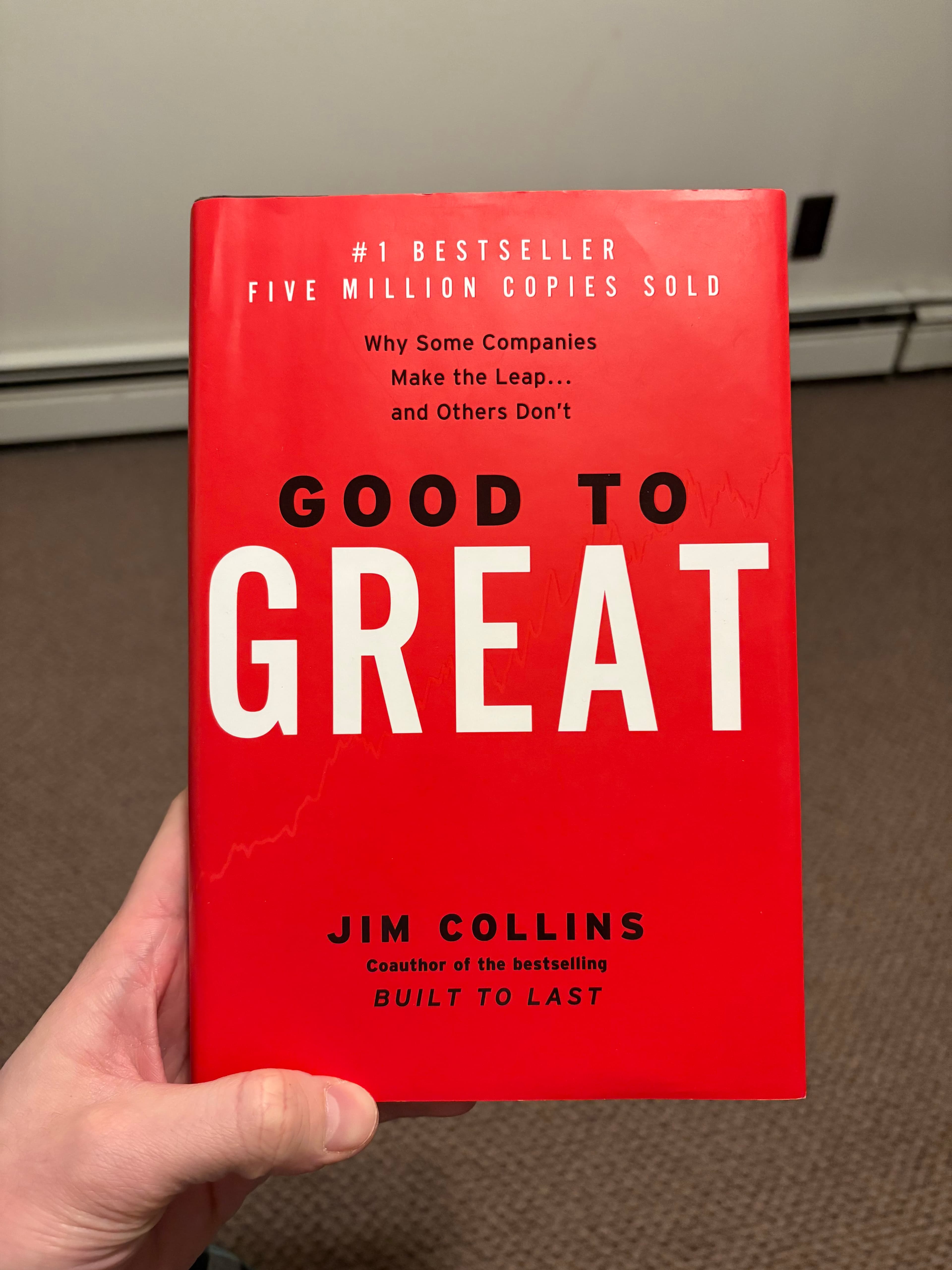
Good to Great
by Jim Collins
Date Read: February 6, 2026
Summary
In Good to Great, Jim Collins and his research team identify a set of elite companies that transitioned from average performance to sustained excellence, outperforming the general stock market by several multiples over 15 years. The book dismantles the myth of the "celebrity CEO" and focuses instead on a disciplined framework of people, thought, and action. Collins argues that greatness is not a function of circumstance, but a matter of conscious choice and discipline.
The transition follows a specific trajectory: disciplined people lead to disciplined thought, which leads to disciplined action. This process creates a "Flywheel" effect—where small, consistent wins build momentum over time until a breakthrough occurs. Unlike the "Doom Loop" of reactionary changes and restructuring, great companies stay the course by sticking to their core competencies and hiring the right people before deciding where to drive the bus.
My Favorite Takeaways
- Level 5 Leadership: The most successful leaders aren't flashy or charismatic; they are humble, quiet, and possess a paradoxical blend of personal humility and professional will. They look in the mirror when things go wrong and out the window when things go right.
- First Who, Then What: Before setting a vision or strategy, get the right people on the bus (and the wrong people off). If you have the right people, the problem of how to motivate and manage them largely goes away.
- The Hedgehog Concept: Greatness comes from the intersection of three circles: what you are deeply passionate about, what you can be the best in the world at, and what drives your economic engine. If you can't be the best at it, it shouldn't be your core business.
- The Stockdale Paradox: You must maintain unwavering faith that you will prevail in the end, regardless of the difficulties, while simultaneously confronting the most brutal facts of your current reality.
- Technology Accelerators: Great companies never use technology as the primary creator of momentum. Instead, they use carefully selected technology to accelerate the momentum they have already built through their Hedgehog Concept.
Real World Application
The "Flywheel" is a perfect metaphor for career and personal growth. Success rarely comes from a single "lucky break" or a "big bang" moment. It comes from the accumulation of small, disciplined efforts that eventually reach a tipping point.
Applying the "First Who" principle to life means being incredibly selective about your inner circle. Whether in a startup or a friendship group, the quality of the people around you will dictate the ultimate destination more than any roadmap ever could. Avoid the "genius with a thousand helpers" model; instead, build a culture of rigorous self-discipline where management becomes unnecessary.