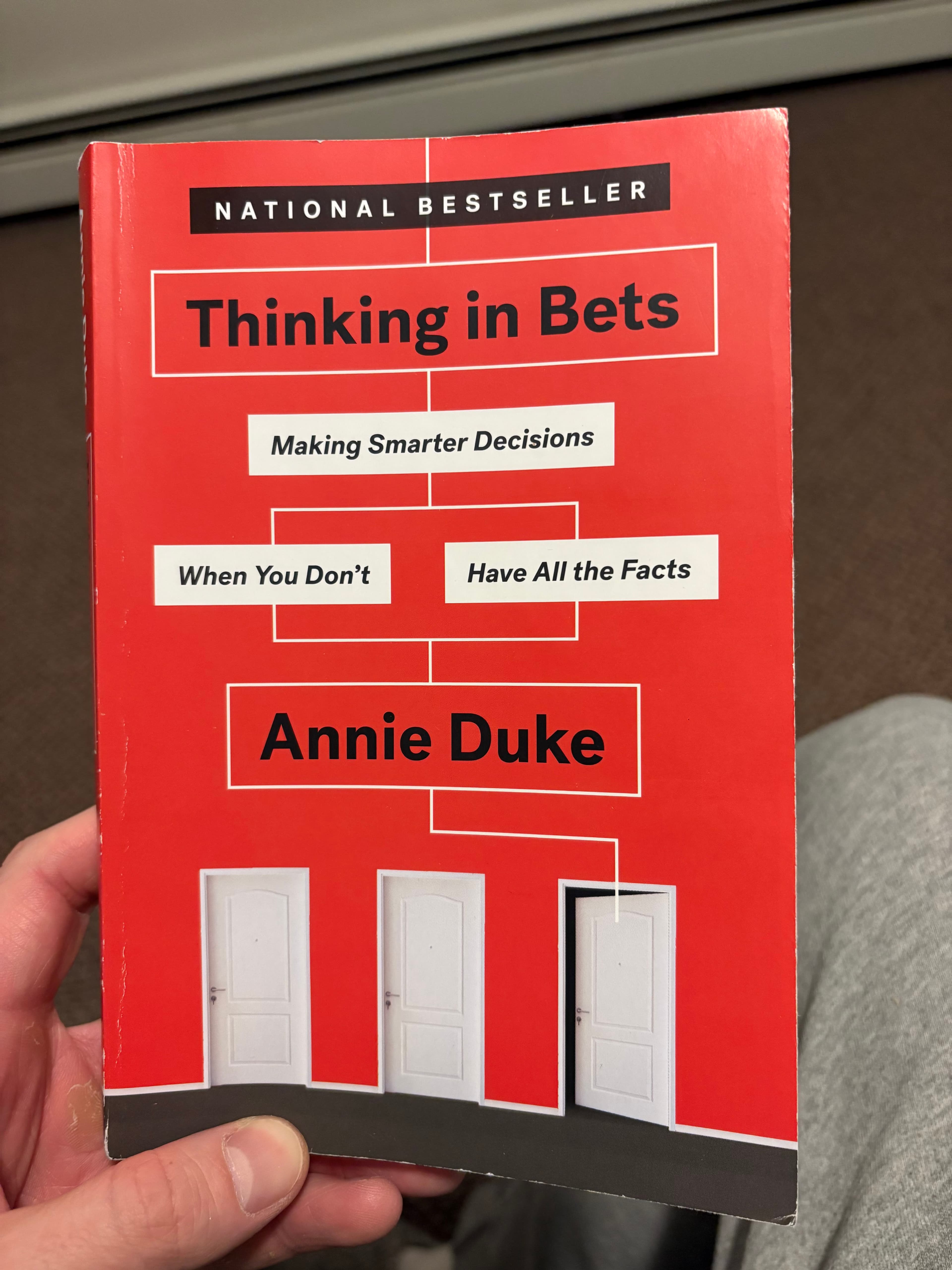
Thinking in Bets
by Annie Duke
Date Read: January 22, 2026
Summary
In Thinking in Bets, former World Series of Poker champion Annie Duke explores how to navigate a world where we rarely have all the facts. She argues that our lives are a series of bets based on our beliefs, which are often biased and incomplete. The book's central thesis is a rejection of "resulting"—the flawed habit of equating the quality of a decision with its outcome—and "hindsight bias," which makes us feel that a result was inevitable once it has occurred.
By treating decisions as poker hands rather than chess moves, Duke provides a toolkit for making better choices under pressure. She teaches readers how to detach their egos from their ideas, embrace the "I'm not sure" mindset, and use "temporal distancing" to view current problems from a long-term perspective. Ultimately, the book is a guide to shifting your focus from the unpredictable results of life to the logic of the decision-making process itself, ensuring that even when you lose a "bet," you still gain the data necessary to win the next one.
My Favorite Takeaways
- Ditch "Resulting": Stop judging decisions solely by their outcomes. Life is more like poker than chess; it involves luck and hidden information. Making peace with the "grey area" and accepting uncertainty is the first step toward genuine growth.
- Beliefs as Bets: Our beliefs aren't objective truths; they are often biased filters. By viewing your certainty as a percentage (e.g., "I'm 60% sure") rather than a binary "right or wrong," you become more open to new information and a better collaborator.
- Luck vs. Skill: To grow, you must objectively "field" outcomes. Don't fall for the ego trap of blaming bad luck for failures while taking total credit for successes. Emulate pros like Phil Ivey: admit mistakes, give credit to others, and let your learning compound.
- Build a Truth-Seeking Circle: Success is easier when you're surrounded by people who challenge you rather than just agree with you. Use these groups to hold yourself accountable, avoid echo chambers, and practice explaining your reasoning before you act.
- Radical Transparency: Combat your brain's natural bias by sharing every detail—especially the ones you want to hide. Don't "shoot the messenger," withhold your opinion until others have spoken, and always acknowledge points of agreement first to lower defensiveness.
- The Power of Time Travel: Use the 10-10-10 rule to zoom out and consult your future self. Tools like "backcasting" from success or "pre-mortems" on failure help you evaluate choices rationally before emotions take over. Wean yourself off the "outcome addiction" to find true contentment.
Real World Application
We often struggle with regret because we feel we "should have known" how things would turn out. In reality, you can only make the best bet given what you know at the moment. Accepting that good bets can lose and bad bets can win is liberating. It allows you to separate the quality of your decisions from the luck of the outcome.
Embracing uncertainty is a strength, not a weakness. Being comfortable saying "I'm not sure"—or "I'm 60% sure"—allows for more honest collaboration and better decision making. Seek out people who challenge your views rather than just agreeing with you, as this prevents echo chambers.
Finally, avoid being a "ticker watcher" in life. Zooming out during stressful moments helps verify if the current problem will actually matter in 10 months or 10 years. Instead of complaining about bad luck, analyze what could have been done better. Luck is a huge factor in life, but focusing on your process ensures you are ready when the next opportunity arises.