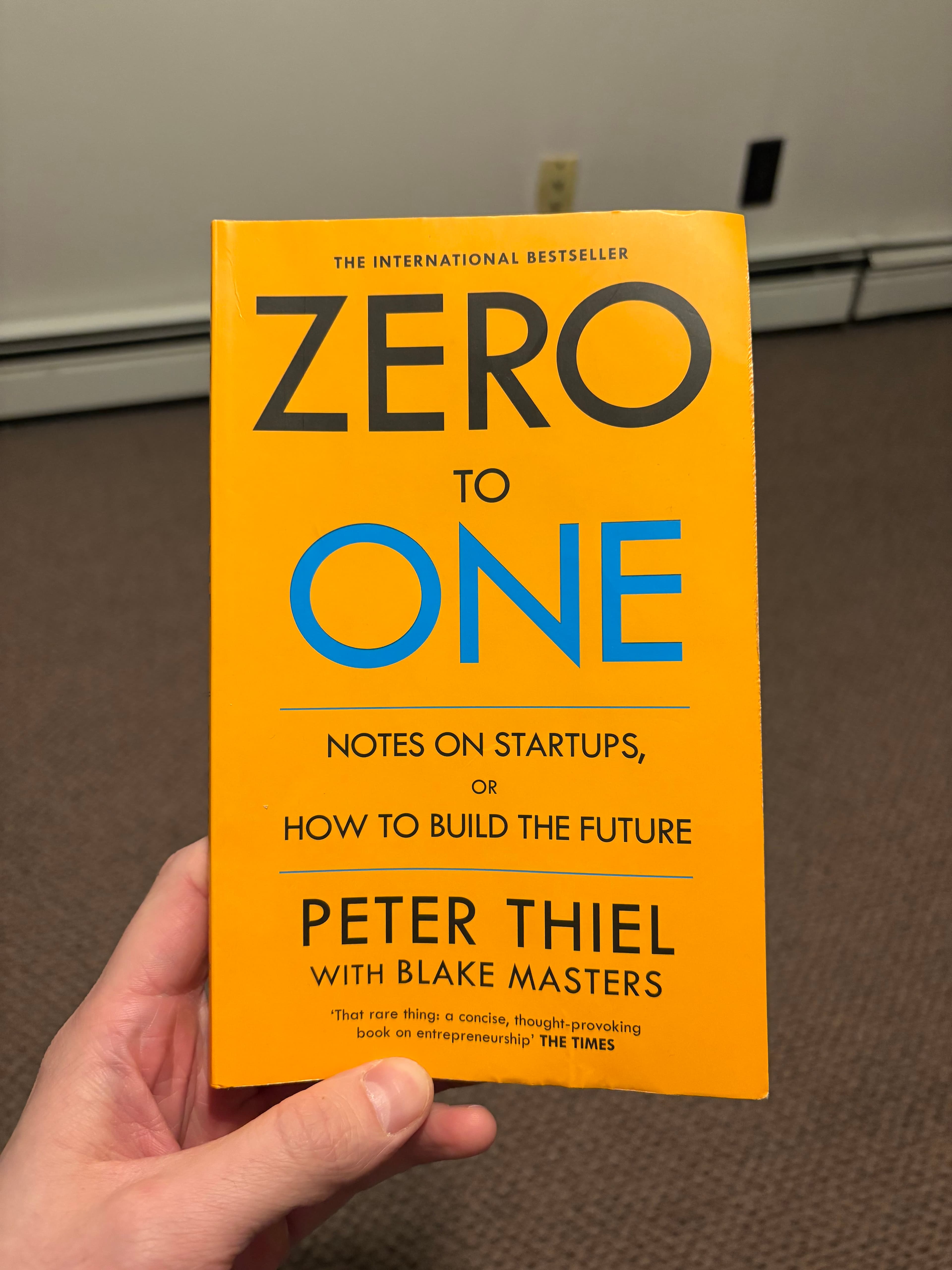
Zero to One
by Peter Thiel
Date Read: February 13, 2026
Summary
Zero to One is a contrarian manifesto on innovation. Peter Thiel argues that we live in an age of technological stagnation, hidden by the flashiness of mobile devices. Most people focus on "1 to n"—copying things that already work (horizontal progress). True innovation is "0 to 1"—creating something entirely new (vertical progress). Thiel posits that the next Bill Gates won't build an operating system, and the next Mark Zuckerberg won't build a social network.
The book challenges the standard economic praise for competition, arguing instead that "competition is for losers." To build a massively successful company, one must seek to build a creative monopoly. By doing something 10x better than anyone else or solving a problem no one else is looking at, a company can escape the cutthroat margins of a competitive market and earn the profits necessary to keep innovating.
My Favorite Takeaways
- The Contrarian Question: "What important truth do very few people agree with you on?" Most answers are based on the present, but good answers look toward the future. This is the starting point for any 0 to 1 business.
- Monopoly is the Goal: Competition destroys profits. A "Creative Monopoly" is a company so good at what it does that no other firm can offer a close substitute. Think Google in search.
- The Power Law of Venture Capital: In startups, a small handful of companies (or investments) will outperform all others combined. You should only start a business or join a team if you believe it has the potential to be that one-in-a-million outlier.
- Secrets: Every great business is built around a secret—something true but difficult, or something known only to a few. If you believe there are no more secrets left to find, you’ll never look for the 0 to 1 opportunities.
- Sales is Everywhere: Even the most brilliant product won't sell itself. Engineers often overlook this, but distribution is as important as the product. If you’ve invented something new but haven’t invented an effective way to sell it, you have a bad business.
Real World Application
Thiel’s philosophy encourages us to stop competing in crowded spaces. If you are doing what everyone else is doing, you are fighting for crumbs. Whether you are choosing a career path or a project, look for the "unpopular" or "ignored" niche where you can become the undisputed expert.
The most important lesson is to think for yourself from "First Principles." Don't just follow the "lean startup" dogmas of incremental improvement. Have the courage to have a "Definite Plan" for the future. Even a bad plan is better than no plan at all, because a plan allows you to act with intention rather than reacting to the chaos of the market.